Capturing Every Word: Choosing the Right Microphone for Genealogy Conversations
Why Microphones Matter in Genealogy Interviews
Family history conversations are once-in-a-lifetime moments. The way you record them directly impacts what you preserve for future generations. Many times, these talks happen at kitchen tables, in living rooms, or during reunions — places with background noise, overlapping voices, and unpredictable interruptions.
Affiliate Disclosure: This post contains affiliate links, which means I may earn a small commission if you purchase through my links, at no additional cost to you. I only recommend products I use myself or that I believe will bring value to your genealogy projects.

Your choice of microphone determines whether you’ll walk away with crystal-clear, usable audio or an unintelligible jumble. And the truth is — you never know when these opportunities will arise.
Portability is Key for Genealogists
One of the best things about small wireless systems like the RODE Wireless PRO Compact Wireless Microphone System is that they’re compact enough to throw in your bag without a second thought. You can carry them to family reunions, holiday gatherings, or even casual coffee meetups without needing extra gear. If a conversation starts, you’re ready — no scrambling for power cords, stands, or adapters.
Similarly, the RØDE VideoMicro series is perfect for keeping in your camera bag if your camera supports external mics. They’re lightweight, always ready to go, and instantly improve sound quality compared to your camera’s built-in microphone.
Understanding Microphone Types for Conversations
1. Dual-Channel Lavalier Microphones (Best for Two-Person Interviews)
Dual-channel wireless systems are perfect for genealogy interviews. Each person wears their own mic, which means you capture both sides of the conversation without one voice overpowering the other.
- Why dual channel is better than single channel:
- Records both speakers independently.
- Avoids cutting off the second speaker when voices overlap.
- With a single-channel system, you’d likely need two sets to record a proper two-way conversation.
Here’s what that looks like in practice:
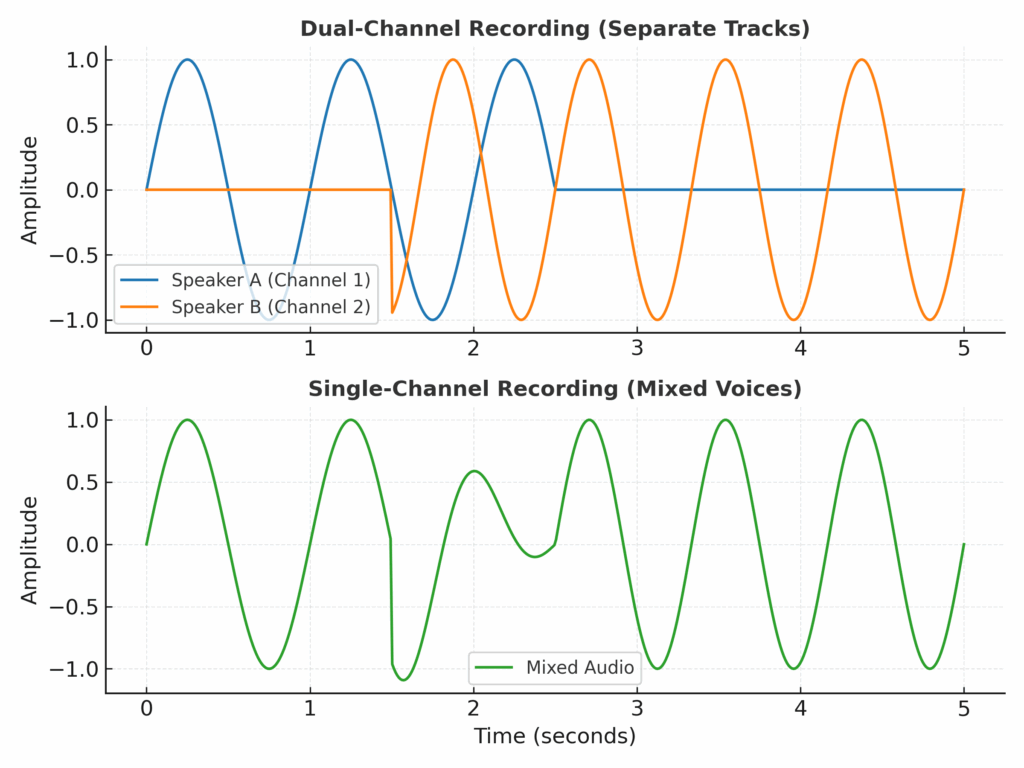
With dual-channel recording, each person’s voice is kept on a separate track, so nothing gets lost. With single-channel recording, voices are blended together, making it harder to separate speakers and sometimes losing clarity when people talk over each other.
2. Room Microphones vs. Boom Microphones
Room microphones and boom microphones may look similar, but they’re designed very differently:
- Room microphones capture sound from multiple directions — perfect for 3+ person conversations around a table.
- Boom microphones are highly directional, focusing only on sound in front of them. This can cause voices from the side or behind to be faint or lost entirely.
Microphone Pickup Patterns Explained
The diagram below shows the difference between common polar patterns:
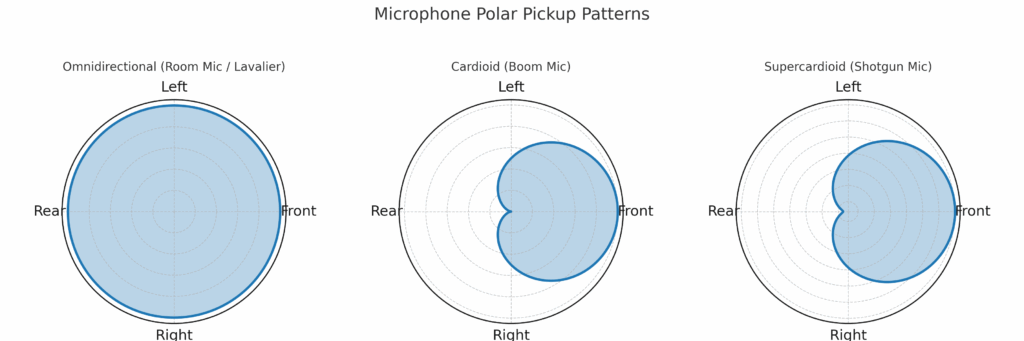
- Omnidirectional (left) — Picks up sound equally from all directions, great for room mics and lavaliers in small settings.
- Cardioid (middle) — Focused on the front, rejecting sound from the rear, ideal for single-speaker setups.
- Supercardioid (right) — Extremely directional, suited for controlled environments where you want to isolate a voice.
Recommended Microphones for Genealogy Conversations
Dual-Channel Wireless Lavalier Systems
All microphones are listed as best sellers or have
- RODE Wireless PRO Compact Wireless Microphone System – My go-to: includes 2 lavaliers, 32-bit float onboard recording, timecode, and a smart charge case. Reliable backup recording means you won’t lose audio if wireless connection drops.
- Bonus: Add the RØDE Interview GO Handheld Adapter for a handheld mic option.
- DJI Mic 2 (2 TX + 1 RX + Charging Case) – 32-bit float internal recording, intelligent noise canceling, and 820 ft range.
- Hollyland Lark M2 – Long 1000 ft range, 30-hour battery, and noise cancellation.
- PQRQP 3-in-1 Wireless Lavalier Mic – Works with iPhone/Android/camera.
- Mini Mic Pro – Crystal-clear audio in a tiny package.
Single-Channel Wireless Lavalier Systems
(Best for solo recording; not ideal for two-way interviews unless you buy two sets.)
- DJI Mic Mini (1 TX + 1 RX) – Compact, light, and easy to use.
Room & Boom Microphones
(One-Directional audio is best for solo recording; not ideal for two-way interviews unless you buy two sets. They can also be mounted on a camera to record the conversations happening in front of the microphone.)
- RODE VideoMicro – Compact shotgun mic for focused one-direction audio. This is a favorite on Amazon with over 20,500 reviews.
- RØDE VideoMic GO II – USB or 3.5mm connectivity for filming or podcasting. This is also a one-direction audio microphone.
- Tip: Pair with the RØDE DS2 Desktop Studio Arm for desk-based interviews.
Tips for Recording Genealogy Conversations
- Carry portable gear so you’re ready for spontaneous interviews.
- Use dual-channel systems when possible.
- Clip lavaliers close to the collarbone.
- Monitor audio in real-time.
- Choose room mics for group talks, lavaliers for one-on-one interviews.
Final Thoughts
In genealogy, you rarely get a second chance to record a story. The right microphone — especially one that’s portable and easy to set up — ensures that future generations will hear the voices, laughter, and emotions exactly as they happened.
Looking for inspiration on what to ask?
Check out my post, 20 Conversation Starters for Your Next Genealogy Interview, for tips and ideas on how to draw out the most meaningful stories from your relatives.